Fragile Autonomy: Why Delegation Collapses Under Pressure
Fragile Autonomy: Why Delegation Collapses Under Pressure
When you first hire someone capable and hand over a piece of the business, it feels like progress. Decisions move without you. The inbox gets a little lighter. You feel the first hint of breathing room.
Then a few things start to slip. A pricing exception lands on your desk to be “double-checked.” A client pushes the scope of a project and the team hesitates. A staff issue drifts because no one is quite sure where the line is.
The hard calls return. Not all of them. Just the ones that matter — the ambiguous ones, the trade-offs, the decisions that reveal what your standards really are when things get complicated.
So you step back in. And gradually, you become the human backstop for the business again.
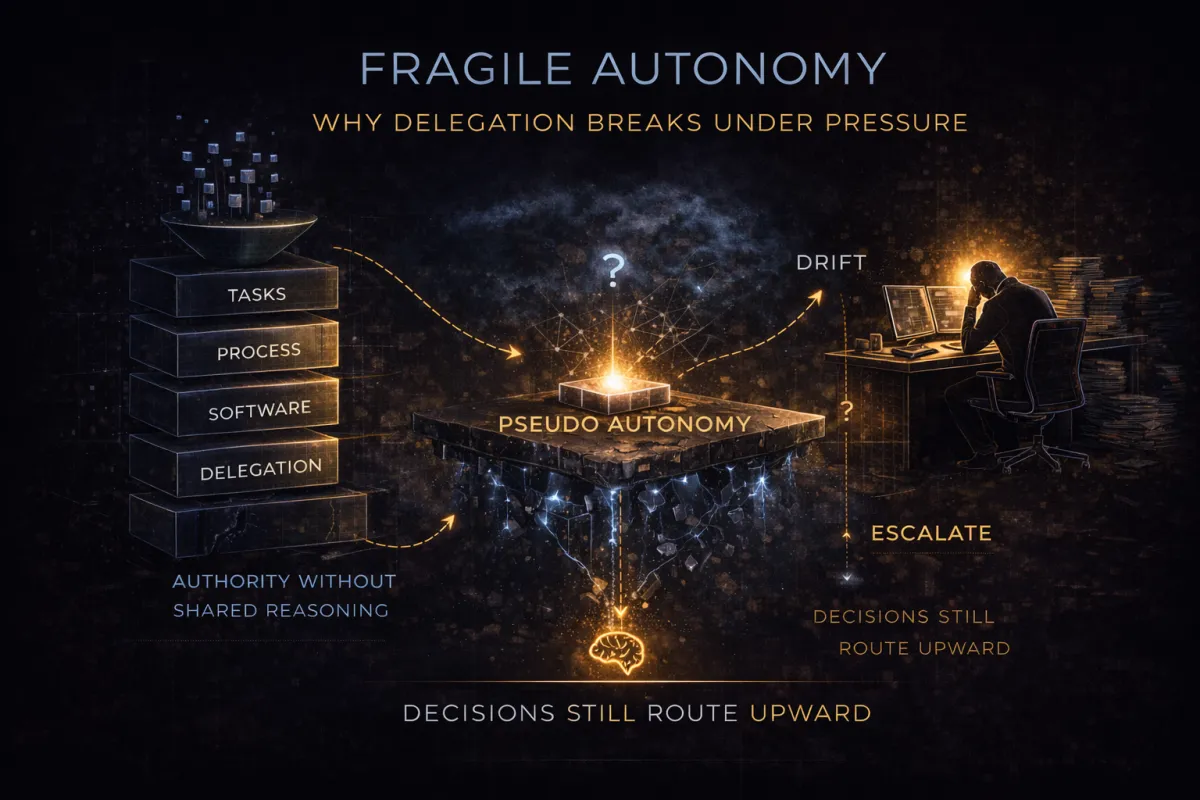
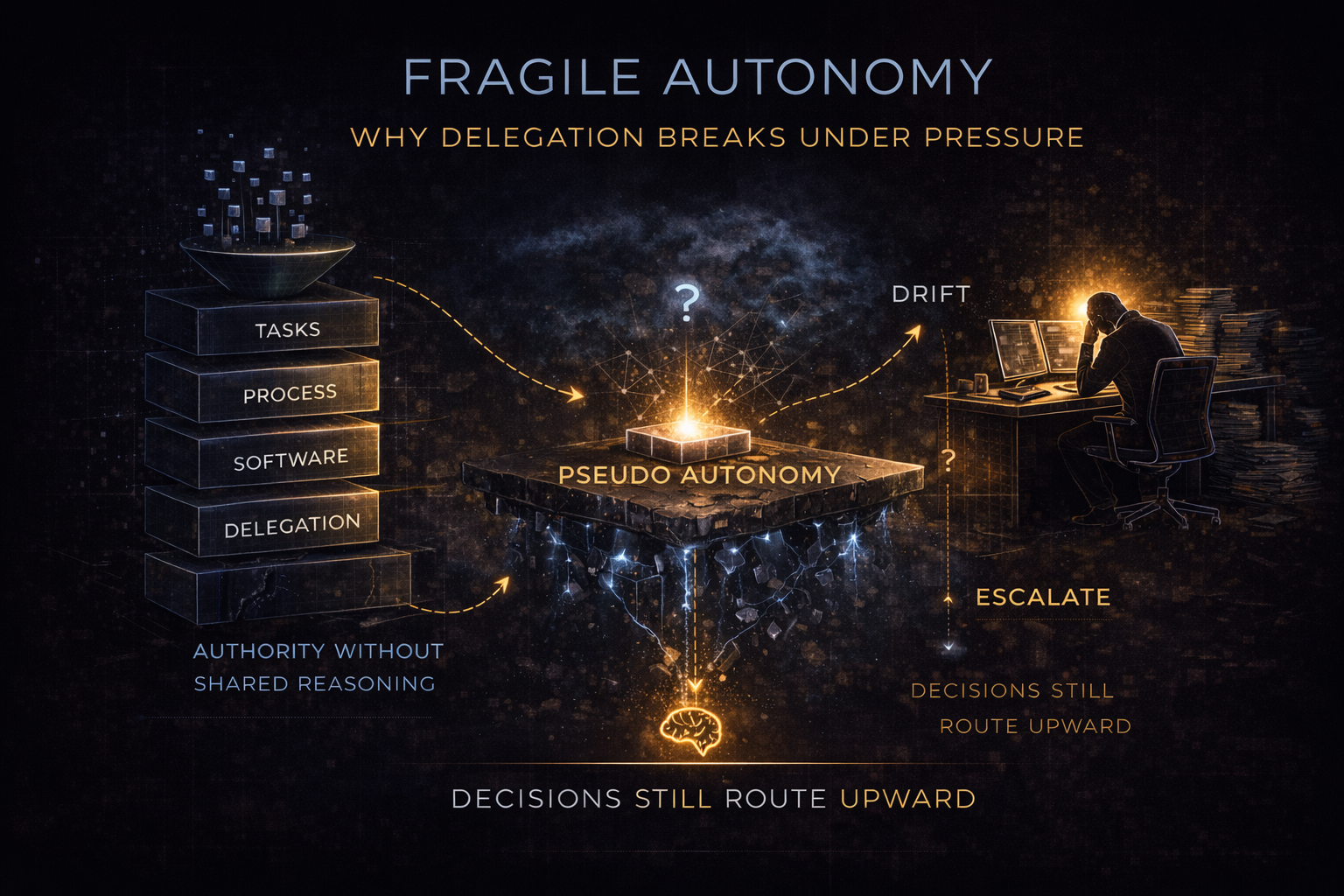
I’ve seen this pattern so many times that I’ve started calling it Fragile Autonomy. It’s what happens when a founder successfully distributes authority, but fails to distribute the reasoning that makes that authority useful under pressure.
The Missing Layer
Most growing businesses are built on three intentional layers: the tasks that get done, the processes for how to do them, and the decision rights that say who is allowed to decide. Very few build the fourth: the layer that explains how decisions are evaluated when the rules run out.
When that fourth layer is missing, your team faces two rational choices when they hit a grey-area problem. They can either guess, using their own criteria to make a call. Or they can bring the decision to the person whose standards ultimately determine the right outcome.
Good operators almost always choose the second option. They bring it back to you. Which means the problem isn’t a failure of capability on their part. It’s a signal that the business is designed to rely on your thinking.
Authority Is Not Autonomy
Handing over authority answers the question: Who decides? For your team to have genuine autonomy, they need the answer to a different question: How do we decide well when we’re under pressure?
You carry a set of internal thresholds that feel obvious to you. You know when a profit margin is non-negotiable, and when a relationship is worth bending for. You know when speed matters more than perfection, and when a risk is acceptable. Those thresholds weren’t written down in a manual; they were built through years of experience — cashflow scares, difficult clients, hiring mistakes, and reputation hits.
When you hand over authority without finding a way to make those hard-won heuristics visible, the autonomy you grant is provisional. Your team knows that even if they are “allowed” to decide, their decision can be reversed if it doesn’t align with the unwritten rules. And when authority feels reversible, bringing the decision back to you is always the safest move.
This is the essence of Fragile Autonomy. It works, until it’s tested.
The Weight You Carry
This is where the design problem becomes a personal one. Every time a hard call comes back to you, it’s a context switch. You’re pulled from pricing to staffing, from delivery to cashflow, from a client’s tension to your team’s morale. You’re not just answering a question; you are reloading the entire context of a situation, which is one of the most expensive things your brain can do.
This is why it feels impossible to switch off. Even when you are technically “off,” you are on standby, waiting for the next ambiguous situation that doesn’t fit the template. The system still depends on your ability to recognise the pattern and make the call.
The Compounding Cost
This fragility compounds quietly. When your team has to guess how you’d think, rework increases and trust subtly erodes. Pricing and risk thresholds fluctuate because they are based on individual interpretation, not a shared understanding. Execution slows down because decisions wait for you, and clients feel the delay. And your best people feel like their ownership is conditional, which is a feeling that good people rarely tolerate for long.
But the deepest cost is to the founder. Ambiguous decisions consume more of your mental energy than routine ones. Over time, the very person whose judgement matters most becomes the most overloaded. If the business cannot make high-quality decisions in your absence, it is fragile — regardless of how much revenue it’s generating. Buyers recognise this. So do senior hires. And so does your own nervous system.
Building the Missing Layer
Most founders try to solve this with clearer processes, stronger hires, or more software. Those things improve coordination. They do not distribute reasoning. You can assign a task, but you can’t assign a brain.
There is a structural layer beneath delegation that most businesses never build. It’s the layer that extracts the recurring patterns in your judgement, makes your criteria for trade-offs legible to others, and aligns your team’s authority with a shared model of how to think.
This is hard work. It requires you to stop teaching people what to do, and start the much harder work of teaching them how you think. It’s the difference between a business that runs on your personal intelligence, and one that has an institutional intelligence of its own.
The Real Scaling Test
Growth is visible. You can see the revenue, the headcount, the systems. The ability to scale your thinking is quieter. It’s measured by a different question:
If you stepped away for two weeks, would the hard decisions get resolved well — or would they stack up in a list, waiting for you to get back?
If every ambiguous call still ends up with you, the business has grown. It hasn’t scaled. The bottleneck is the same; there’s just more volume feeding into it.
The shift required is architectural. And the businesses that endure will be those that deliberately design how their intelligence moves — before the founder’s brain becomes the bottleneck that no amount of effort can fix.

