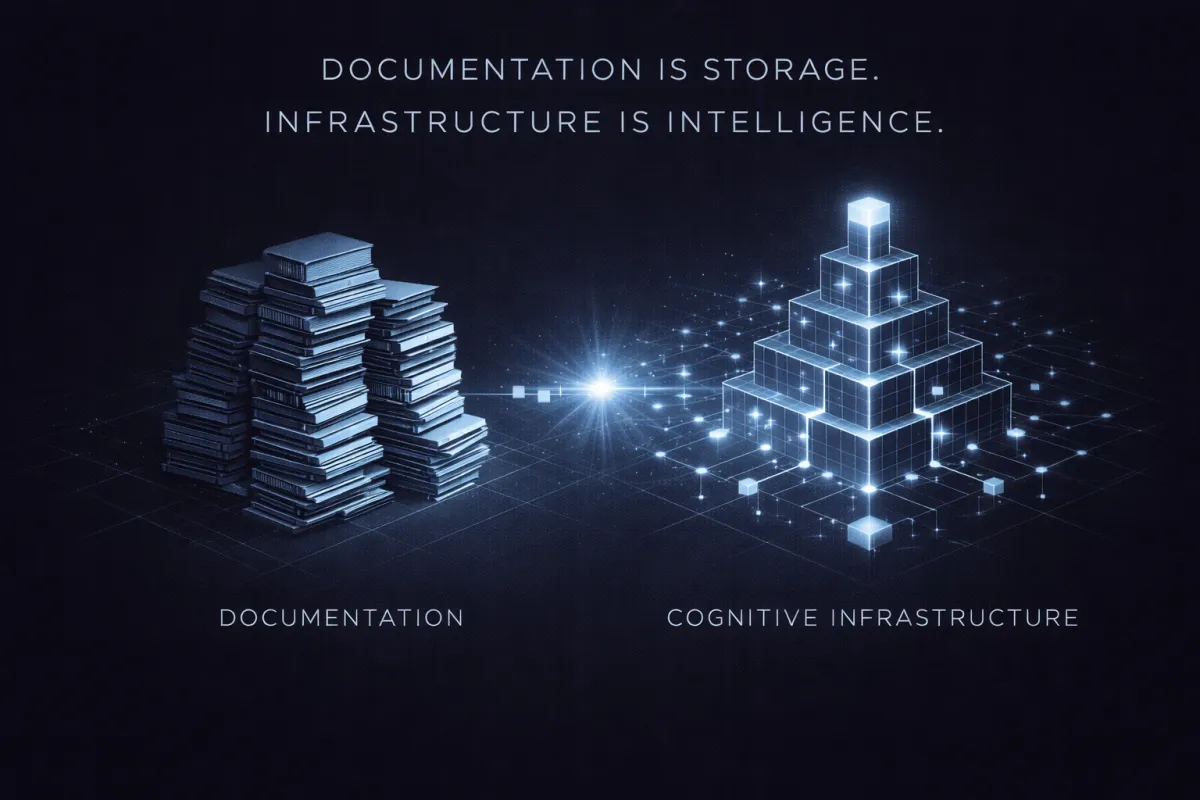
The Missing Layer Between Documentation and Scale
Cognitive Infrastructure: The Missing Layer Between Documentation and Scale
Most founder-led companies hit the same invisible ceiling.
Revenue grows.
Headcount expands.
Documentation improves.
Yet escalation does not decrease.
The founder remains the final interpretation layer.
This is not a leadership problem.
It is an architectural one.
Most organisations attempt to scale execution.
Very few design how they scale judgement.
That gap is what I call Cognitive Infrastructure.
The Structural Tension
Documentation solves repetition.
Scale requires adaptive capacity.
Standard operating procedures are effective under normal conditions. They reduce variance, improve training efficiency, and create operational clarity.
But they do not encode how to:
Interpret ambiguous information
Weigh competing principles
Resolve edge-case trade-offs
Apply strategic intent across contexts
When ambiguity appears, the system pauses.
Decisions escalate upward.
Latency compounds.
The organisation becomes efficient — but cognitively centralised.
This is the structural distinction between growth and scale.
Growth increases output.
Scale distributes intelligence.
Why This Problem Persists
Management theory has recognised parts of this issue for decades.
Michael Polanyi distinguished between explicit knowledge (what can be written) and tacit knowledge (what is embodied in experience). We know more than we can tell.
Karl Weick showed that organisations continuously construct meaning. They do not simply retrieve information; they interpret reality.
Edwin Hutchins demonstrated that cognition is distributed across people, tools and environments — intelligence is a system property, not an individual one.
Stafford Beer’s Viable System Model described the minimum functions required for organisational viability: operations, coordination, control, intelligence and policy.
These frameworks converge on a simple truth:
Organisations are cognitive systems.
Yet most scaling efforts focus on process, not cognition.
Documentation handles coordination.
It does not distribute intelligence.
That is the missing layer.
The Category Error
Many companies assume documentation is infrastructure.
It is not.
Documentation is storage.
Knowledge management is retrieval.
Infrastructure determines how a system behaves under stress.
Roads are infrastructure.
Electrical grids are infrastructure.
Operating systems are infrastructure.
Infrastructure is not a record of how to act.
It is the architecture that enables distributed action.
Cognitive Infrastructure is the structured system that captures, encodes, distributes and scales a company’s decision-making intelligence beyond the founder’s brain.
It does not eliminate judgement.
It does not automate leadership.
It does not replace discretion.
It structures how judgement propagates through the organisation.
A Structural Distinction
To clarify the boundary:
LayerDocumentationKnowledge ManagementCognitive InfrastructureEncodesTasks and sequencesInformation and artefactsJudgement and trade-offsAssumesStable conditionsRetrievable answersAmbiguity and edge casesScales byReplicationAccessDistribution of intelligenceFails whenConditions shiftInformation overloadArchitecture becomes rigid
Documentation is necessary.
It is not sufficient.
Without Cognitive Infrastructure, companies move from founder-led to machine bureaucracy — efficient, but fragile under complexity.
The Economic Reality
This is not abstract theory.
Centralised cognition caps throughput.
When every ambiguous decision requires founder review:
Decision latency increases
Strategic consistency fluctuates
Senior leadership time fragments
Organisational confidence declines
Jensen and Meckling’s work on decision rights highlights the trade-off: keeping decisions central reduces agency risk but increases delay cost.
As complexity rises, delay cost compounds.
Ashby’s Law of Requisite Variety states that only variety can absorb variety. If environmental complexity increases but adaptive capacity remains centralised, the system becomes structurally overloaded.
That overload shows up in valuation.
Founder-dependent firms attract key-person discounts. Buyers price in fragility. Enterprise value reflects structural independence, not founder stamina.
Scale is not revenue growth.
Scale is the organisation’s ability to think without a single node.
What Cognitive Infrastructure Actually Designs
Cognitive Infrastructure operates across four structural layers:
1. Decision Extraction
Identifying recurring strategic judgement patterns embedded in the founder’s thinking.
2. Judgement Encoding
Translating those patterns into explicit decision criteria, trade-off frameworks, and boundary conditions.
3. Authority Distribution
Allocating decision rights according to knowledge proximity and risk tolerance, rather than hierarchy alone.
4. Feedback Calibration
Ensuring distributed decisions maintain coherence through structured review, not ad hoc escalation.
This is not documentation.
This is organisational cognition by design.
Without these layers, judgement remains personal.
With them, judgement becomes institutional.
Why This Is Not a Tool Conversation
Technology can accelerate decision flow.
It cannot architect decision logic.
Automating inconsistent judgement scales inconsistency.
Standardising complexity removes adaptability.
Cognitive Infrastructure precedes tooling. It determines what is safe to automate and what must remain interpretive.
It is a design discipline, not a software stack.
The Shift in Organisational Design
Over the past three decades, companies have professionalised:
Process discipline
Information management
Tool augmentation
The unresolved frontier is judgement architecture.
Modern markets operate in what the Cynefin framework would call the complex domain — where cause and effect are not obvious and adaptive response matters more than procedural adherence.
In this environment, elimination of discretion is not scale.
It is brittleness.
The next phase of organisational design is not better documentation.
It is designed cognition.
Strategic Implication
Founders often ask: “How do I work less?”
That is the wrong question.
The structural question is:
Can this organisation make high-quality decisions in ambiguous conditions without routing intelligence through me?
If the answer is no, the company has grown — but it has not scaled.
Documentation improves efficiency.
Automation improves speed.
Cognitive Infrastructure improves structural independence.
And structural independence is what converts growth into durable enterprise value.
The companies that endure will not be those that document the most.
They will be those that deliberately architect how their intelligence moves.
That is the discipline.
That is Cognitive Infrastructure.

