You Didn't Hire Wrong
You Didn’t Hire Wrong. You Left a Layer Unbuilt.
You hired someone senior.
Experience. Judgement. Strong references.
Six months later, they’re still asking:
“What would you do?”
Not on routine tasks.
On the grey areas.
A pricing exception.
A long-term client pushing scope.
A staff issue that doesn’t fit policy.
A quality trade-off under time pressure.
You didn’t hire to create another approval layer.
You hired to reduce pressure.
And yet, the pressure hasn’t reduced.
This is the point where most founders misdiagnose the problem.
They assume:
The hire lacks confidence.
Authority wasn’t made clear.
The team needs firmer boundaries.
They just need more time.
But something more structural is happening.
You scaled tasks.
You didn’t scale thinking.
The 5–20 Staff Breakpoint
At five people, centralised judgement works.
You are the system.
Context lives in your head.
Decisions are fast.
Standards are consistent.
Escalation feels efficient.
At twenty people, the same model becomes a constraint.
Ambiguity increases.
Client complexity increases.
Financial exposure increases.
People decisions multiply.
But the cognitive model stays the same.
Everything still routes back to you.
Not because your team can’t execute.
Because the business still doesn’t know how to think without you.
This is the scaling breakpoint no one names.
Where Escalation Actually Comes From
Escalation doesn’t cluster around routine execution.
It clusters around ambiguity.
When to bend a rule for a valuable client.
What “good enough” actually means in practice.
When to protect margin versus protect relationship.
When to move fast and absorb risk.
When to slow down and protect quality.
You carry those thresholds internally.
They feel obvious.
They are invisible to everyone else.
So when ambiguity appears, your senior operator escalates.
Not because they’re incapable.
Because they cannot see your reasoning model.
Good operators escalate rather than drift.
Drift is dangerous.
Escalation is safe.
But escalation has a cost.
Delegation Is Not What You Think It Is
Most founders believe delegation means handing off tasks.
Real delegation is transferring decision-making authority.
But authority without shared reasoning produces two predictable outcomes:
Drift
They decide differently than you would.
Or:
Escalation
They check before deciding.
If the standards in your head aren’t accessible, escalation is rational.
This is not a trust issue.
It is a structural gap between execution and judgement.
The Layer Most Businesses Never Design
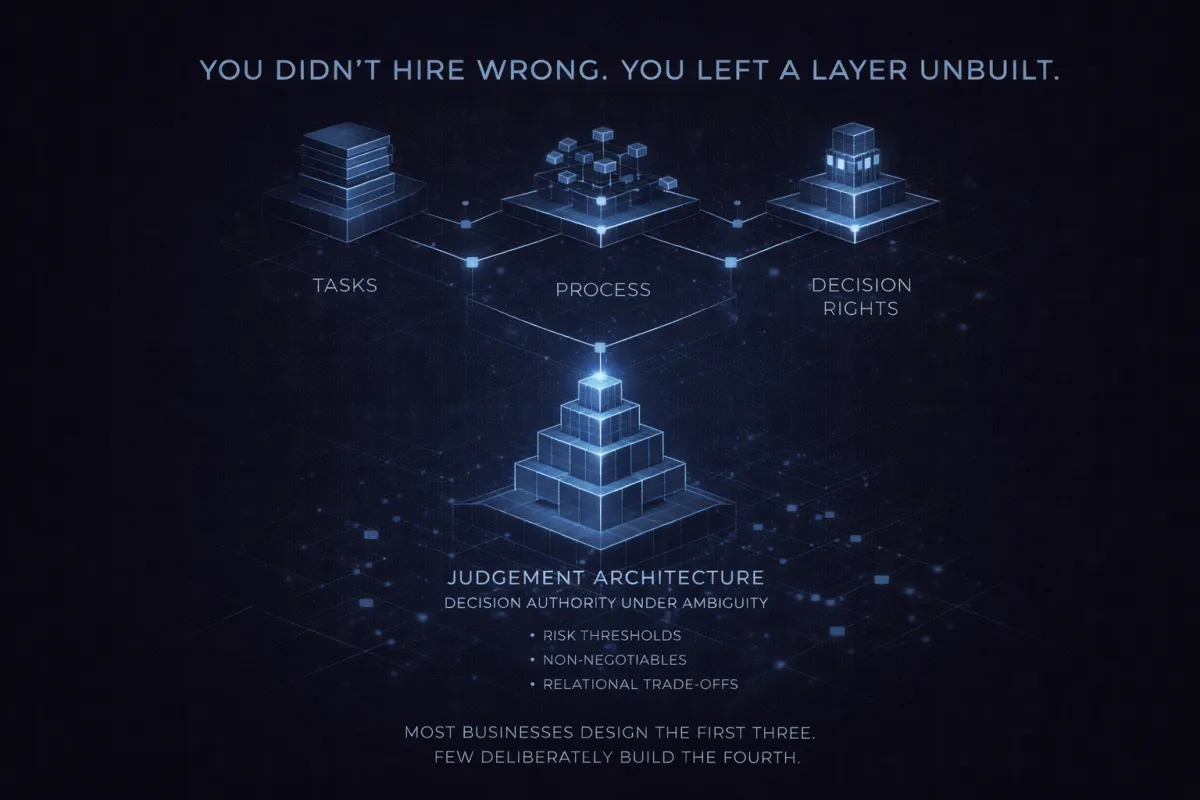
Most founder-led businesses intentionally build three layers:
1. Tasks — What gets done
2. Process — How it gets done
3. Decision Rights — Who is allowed to decide
Almost none intentionally design the fourth:
4. Judgement Architecture — How decisions are evaluated under ambiguity
This layer defines:
What risks are acceptable.
What thresholds are non-negotiable.
When speed outranks perfection.
When margin outranks relationship — and when it doesn’t.
What gets protected even when it’s expensive.
Without this layer:
Authority is provisional.
Even if someone is “allowed” to decide, they know it can be reversed.
And when authority feels reversible, escalation becomes the norm.
This is not poor delegation.
It is incomplete cognitive architecture.
The Topology Problem
Think about how decisions flow in your business.
If every ambiguous decision still routes upward, the authority map is incomplete.
It doesn’t matter how experienced the hire is.
If the reasoning model only exists in one brain, the system has a single cognitive centre.
At five people, that’s efficient.
At twenty, it becomes fragile.
You become:
The safety net
The risk filter
The quality interpreter
The emotional regulator
The final escalation point
That is not leadership strength.
It is a structural scaling constraint.
The Cognitive Cost of Being the Filter
Every escalation forces a context switch.
From pricing to staffing.
From delivery to cashflow.
From client tension to operational detail.
Research on decision fatigue shows sustained decision load depletes the brain’s executive capacity. Ambiguous decisions consume more cognitive energy than routine ones.
So the very person whose judgement the business depends on is the one most cognitively overloaded.
Even when you’re “off,” you’re on standby.
Waiting for the next issue that doesn’t fit the template.
This is why you struggle to switch off.
Not because you lack discipline.
Because the system still depends on your pattern recognition.
“We Know More Than We Can Tell”
There’s a deeper reason this gap persists.
Much of your judgement is tacit.
You didn’t learn it from a document.
You built it through:
Mistakes.
Negotiations.
Cashflow scares.
Reputation hits.
Years of pattern recognition.
You weigh risk instinctively.
You sense when a client is pushing too far.
You feel when quality is slipping — even if no metric flags it.
Written processes capture explicit knowledge.
They don’t capture tacit reasoning.
Decision rights frameworks clarify permission.
They don’t transmit judgement.
So your business has:
Operational systems.
But no distributed cognition.
The Economic Consequences
This isn’t theoretical.
It compounds quietly.
Rework increases.
When decisions don’t align with invisible standards, you step back in. You pay twice.
Margins erode.
Pricing exceptions and risk thresholds default upward, slowing response and increasing inconsistency.
Ownership weakens.
When decisions can be reversed at any moment, authority feels fragile. Smart operators hesitate.
Exit value compresses.
Founder-dependent decision systems are discounted because buyers see fragility. If judgement collapses when you step away, the business isn’t independent.
The constraint is not effort.
It is centralised cognition.
This Is Not a Leadership Flaw
This is important.
You did not fail to delegate.
You left a design layer unbuilt.
At small scale, founder-centred cognition works.
At growing scale, it becomes the bottleneck.
The shift required is architectural.
Not motivational.
Not cultural.
Not tool-based.
Architectural.
The Discipline Beneath Delegation
There is a name for the missing layer:
Cognitive Infrastructure.
Cognitive Infrastructure is the structured system that captures, encodes, distributes, and scales a company’s decision-making intelligence beyond the founder’s brain.
Most small businesses invest in:
Accounting systems
Job management systems
Reporting dashboards
Very few invest in how the business thinks under ambiguity.
Operational systems move work.
Cognitive systems move judgement.
If you want your business to run without constant founder intervention, you don’t just need capable people.
You need a designed cognitive topology.
You need decision authority that is durable — not provisional.
You need distributed reasoning, not distributed tasks.
The Real Scaling Question
The next layer of scale is not:
“How do I get better at delegation?”
It is:
“How does this business make high-quality decisions when I am not in the room?”
If the answer is:
“It still needs me,”
Then the architecture is incomplete.
At five people, you can carry the thinking.
At twenty, you become the constraint.
Systems scale.
Centralised cognition doesn’t.
And design determines which one wins.

